Time and Material Software Development: When It Wins and How to Run It Right
 Melissa AshfordCOO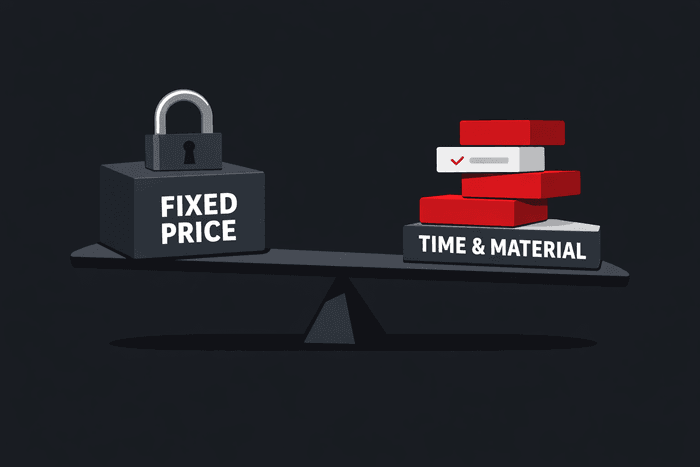
Time and material software development is a contract model where you pay for the hours your team actually works plus the resources they use, instead of locking a fixed price to a fixed scope up front. If your requirements are still moving — and on most real products they are — it's usually the model that gets you a working app faster, with fewer ugly surprises. The catch is discipline. "Pay as you go" only protects you when someone is watching the meter. Run it loosely and it becomes an open tab nobody reads.
We run time and material engagements at Lomray every week — and a lot of them reach us the same way: as a rescue. A fixed-price build that stalled. A contractor who vanished mid-sprint. A codebase nobody can put a clean number on anymore. We built our delivery model around those failure modes because we keep cleaning up after them. So this isn't a brochure for one model over the other — it's the honest version: what time and material really buys you, and where it bites.
What "time and material" actually means
Strip the jargon and it's simple. You agree on an hourly or daily rate per role — say a senior React Native engineer or a backend developer. You agree on roughly how much capacity you want each sprint. Then you're billed for the hours logged against your project, backed by timesheets you can read line by line.
What you are not doing is signing a 40-page spec that pretends you already know every screen and edge case before a single line of code exists. You don't. Neither does anyone else. Time and material accepts that reality instead of papering over it.
Two things make or break it: visibility into where the hours go, and the freedom to change direction without renegotiating the whole contract. Get those right and the model works in your favour. Get them wrong and you're funding motion without progress.
Fixed price vs. time and material
People frame this as a fight. It's really a question of how much uncertainty sits in your scope.
When fixed price makes sense
A fixed-price contract works when the scope is genuinely nailed down and unlikely to shift — a small, well-defined integration, or a migration with a clear before-and-after. You know exactly what "done" looks like and the vendor can estimate it confidently, with little risk the target moves. In those cases fixed price gives you a clean number and a clean finish line.
Where fixed price quietly fails
The trouble starts when scope is fuzzy but the contract pretends it isn't. To cover the unknowns, vendors pad fixed-price quotes — sometimes heavily. Then every change you ask for becomes a "change request" with its own negotiation and its own invoice. And you will ask for changes. The incentive flips: the vendor is now motivated to ship the letter of the spec, not the product you actually need. That's how teams end up technically "on budget" and nowhere near a usable app.
Time and material removes that adversarial layer. There's no change-request tax, because change is the default assumption. You reprioritise the backlog at the start of each sprint and the team builds what matters most right now.
When time and material is the right call
Reach for it when your product is still finding its shape — MVPs and early-stage builds where user feedback keeps reshaping the roadmap mid-flight. It's the right model when scope is large or long-running too, because the further out the finish line sits, the less a fixed estimate is worth and the more a padded one quietly costs you. It fits when you want to start now, while a fixed-price track would have you negotiating a spec for a month before anyone writes code. And it's the only sane choice for a rescue: nobody can fix-price an unknown codebase, so you triage and stabilise first, then bill for the real work.
It's a weaker fit when your budget is hard-capped to the dollar with zero flexibility, or when the scope is so small and certain that a fixed quote carries no real risk.
The real risk, and how to neutralise it
The honest objection is the one everyone raises: "So I just pay open-ended and hope?" No. A well-run T&M engagement has more cost control than a fixed-price one, not less — because you see the spend as it happens instead of discovering it at the end.
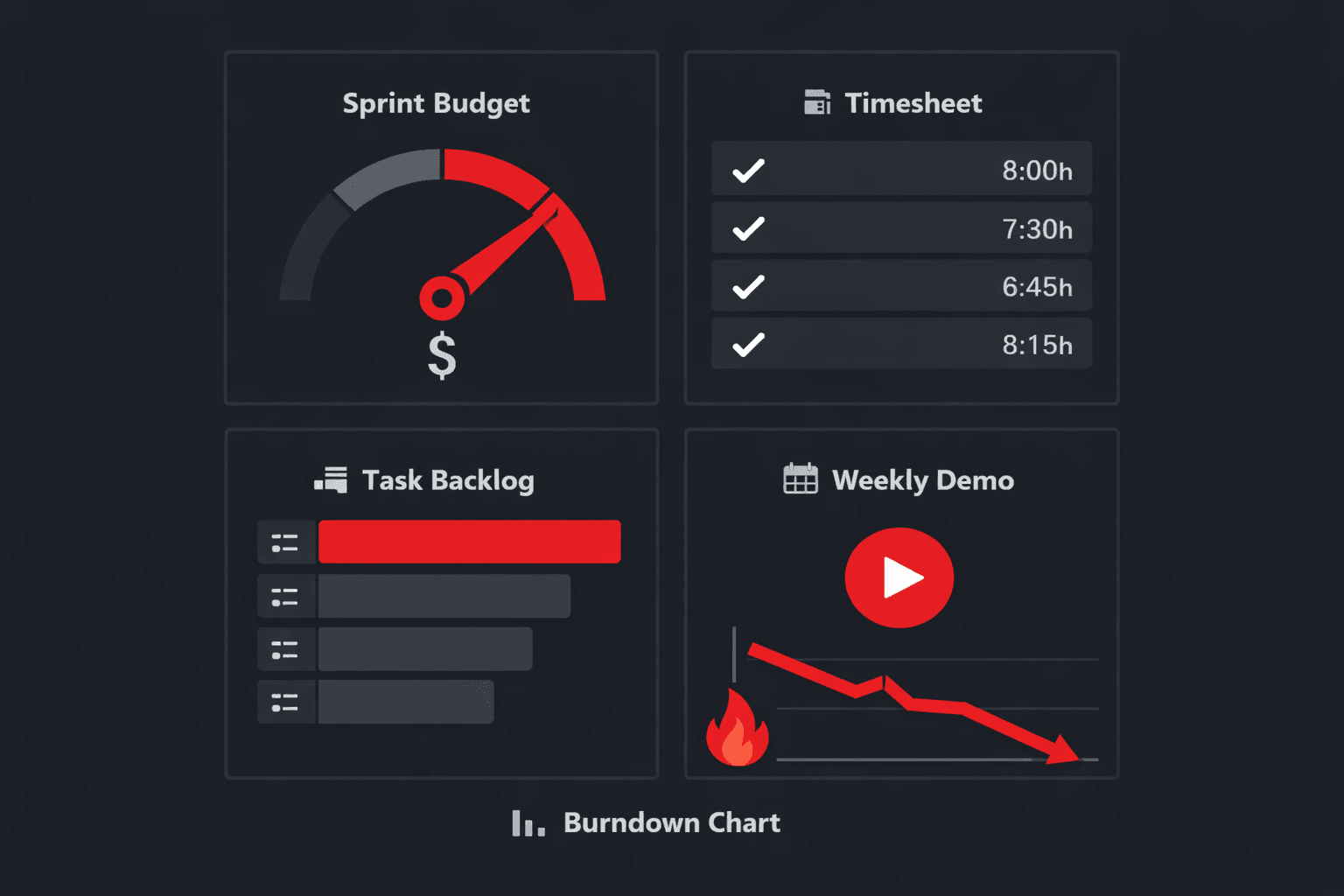
What that control looks like in practice is concrete, not abstract. You set how many hours go into each sprint, so the tab can never run away from you, and you read timesheets logged against specific tasks — you can see that eight hours went to the payment flow, not into a vague "development" bucket, and reorder a backlog you own whenever this week's priorities shift. On top of that you watch working software in a demo every week and follow a burn-down you can actually read, so "are we on track?" becomes a number you point at instead of a feeling you argue about.
Run it that way and time and material isn't a blank cheque. It's a steering wheel.
How Lomray runs time and material
Because so much of our T&M work starts as a rescue, we run it as if something has already gone wrong once — because for our clients, it usually has.
In a T&M engagement the thing you're really buying is trust that the hours are spent well, and that trust only holds when senior people stay close to the code. On our projects they read the architecture decisions and the actual commits, not just the contract — a flexible model drifts the moment nobody experienced is watching, and that oversight is what keeps ours honest.
We demo working software weekly, so you're never more than a sprint away from a course correction. Our developers log timesheets against tasks, which means the spend is transparent down to the feature. And our stack — React, React Native, Node, TypeScript, Next.js — lets a small senior team move fast without the headcount overhead that inflates everyone's hourly bill.
The result is the thing time and material is supposed to deliver and often doesn't. You pay for real progress, you can see it as it happens, and you can change your mind without a fight.
Choosing the model for your project
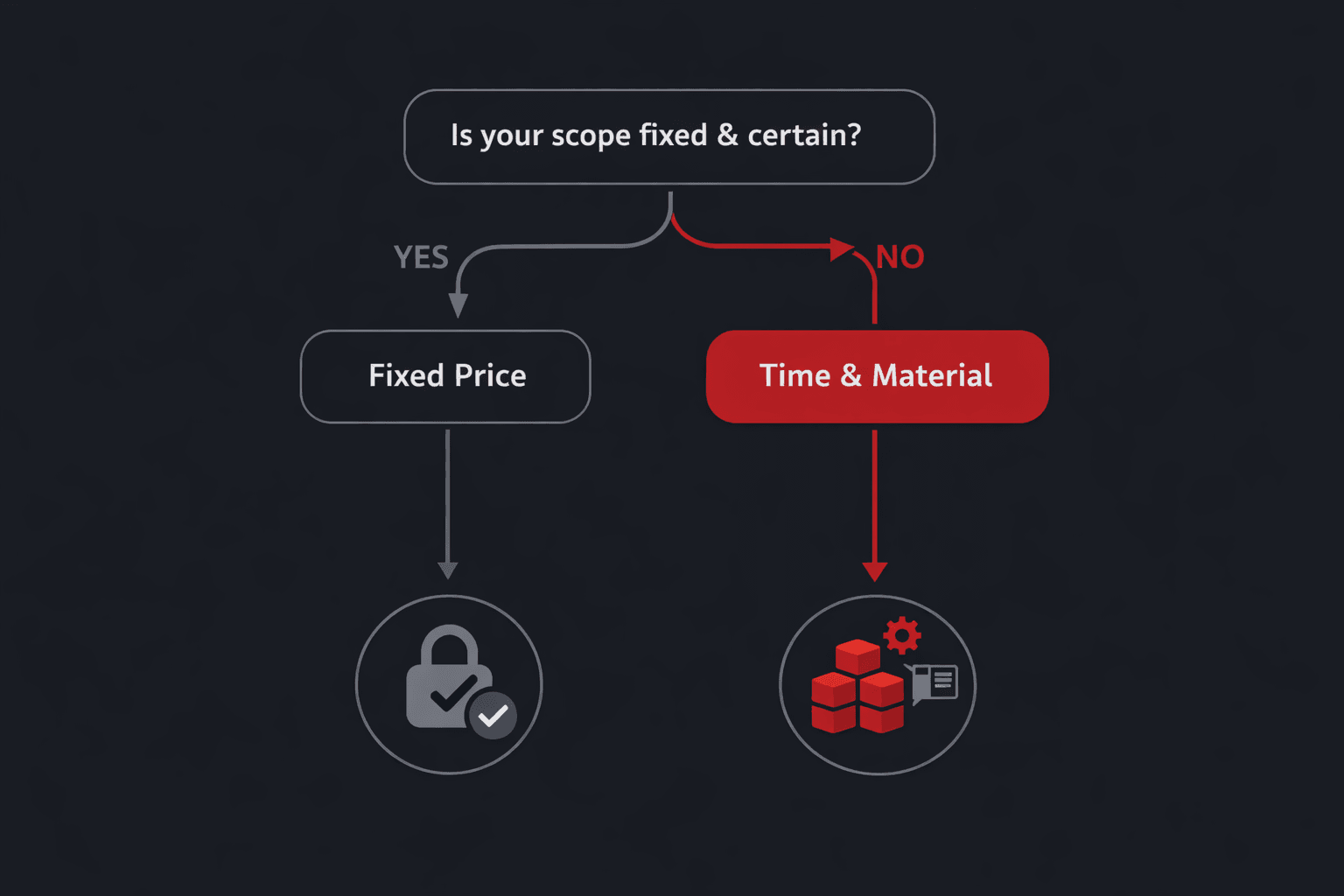
If your scope is small and certain, take the fixed-price quote and enjoy the clean finish line. If you're building something real — a product that will keep evolving, or a codebase you need rescued — time and material will almost always get you a better app for the money. The condition: run it with capped sprints, weekly demos, and timesheets you can actually read.
Not sure which model fits what you're building? Get a straight answer — even when that answer is "fixed price is fine for this one." We'd rather tell you that than sell you a sprint you don't need.
Want the two models side by side, with the middle options and the questions that settle the choice? Read Time and Materials vs Fixed Price: How to Choose in 2026.
Hourly work goes further when the first hours are not spent guessing. If there is an existing site in scope, start from its numbers: audit.lomray.com.